Political Analysis (23): Why Do the Al Khalifa Oppose Palestine? The Path of Normalization and the Convergence Between the Al Khalifa and the Zionists: From Security to Identity
Why do the Al Khalifa oppose Palestine? The question may seem ideologically charged, or merely a rhetorical polemic against the Al Khalifa regime. However, we consider it a fundamental question for understanding the nature of this illegitimate entity and identifying the underlying reasons behind everything that has happened to the people of Bahrain over many decades, up to the present day.
To begin with, we must agree on one fundamental point: the Palestinian cause is, rightly, a sensitive litmus test by which the integrity and consistency of individuals, groups, and regimes can be measured. Over the past years, peoples have witnessed troubling shifts in positions on this cause as a result of overlapping factors. Some relate to the shifting balance of power in the region and the world, while others stem from distortions in cultural and moral standards. Still others arise from internal problems within the peoples themselves and among the forces struggling for liberation. What can be stated with certainty is that the degree of steadfastness on Palestine, or the extent to which one deviates from it, is a decisive criterion for evaluating groups and regimes in general.
How did the relationship between the Al Khalifa and the Zionists begin in the 1990s? What common interests characterized their relationship during that period?
At the very least, the relationship between the Al Khalifa and the Zionists can be traced back to September 1994. This was shortly before the outbreak of one of the largest popular uprisings the country had witnessed prior to the February 14 Revolution of 2011.
At that time, the Zionist Minister of the Environment, Yossi Sarid, visited Manama to participate in an international conference on environmental issues. It was the first visit to Bahrain by an Israeli delegation. Within two years, at the height of the 1990s uprising, former Bahraini Foreign Minister Mohammed bin Mubarak met his Israeli counterpart, Ehud Barak, at the United Nations in 1996. This was followed by trade contacts between the two sides, which remained unofficial at the time.
It is not difficult to discern that security was the connecting thread between the Al Khalifa and the Zionists during that period, as demonstrated by the events of the 1990s uprising and by the use of security methods to suppress citizens and pursue activists and opposition figures. Later, however, it would become clear that security was merely the “gateway” that revealed the deeper and more troubling convergence between the Al Khalifa and the Zionists.
What changed in the relationship between the Al Khalifa and the Zionists after 2000? Why was the ruler Hamad the secret key to the rapprochement between the Al Khalifa and the Zionist entity?
With the end of the 1990s and the beginning of an internal transition following the death of the former emir and the accession of the current ruler, Hamad, to power, the Al Khalifa were expected to reconsider their opening to the Zionists. They should have taken into account the consensus among the people of Bahrain in rejecting the occupying entity and their unequivocal support for Palestine and its resistance.
The ruler and his advisers were aware of the sensitivity of this issue among the Bahraini people. Nevertheless, this did not prevent them from pursuing a course that had been mapped out years earlier, in secret, toward establishing relations with the Zionist entity. At that stage, however, they confined themselves to preparatory steps, gradually developing the relationship until the appropriate moment arrived—when the Al Khalifa could succeed in dismantling the popular unity that had emerged after 2000 and sowing division within the broader national movement.
At the same time, the Al Khalifa took the regional situation into consideration, particularly the positions of the United Arab Emirates and Saudi Arabia regarding relations with the Zionists. At that time, the rulers in Riyadh and Abu Dhabi had not yet reached the point of embracing such relations.
Two key events illustrate this gradual approach. The first occurred in September 2005, when the Al Khalifa officially announced the lifting of the economic boycott of Israel as part of their commitments under the free trade agreement with the United States. The second took place in September 2007, when Bahrain’s then Foreign Minister, Khalid bin Ahmed, met his Israeli counterpart, Tzipi Livni, at the United Nations headquarters in New York.
How did relations between the Al Khalifa and the Zionists mature behind the scenes in New York? What event exposed the final thread connecting the two sides?
As ruler Hamad began to reveal his covert plan to alter Bahrain’s demographic composition and sow division among opposition groups, while also introducing mercenaries and naturalized citizens into the country’s public sphere, the momentum toward the Zionist entity increased at an unprecedented rate. Rapprochement between the two sides expanded publicly and across multiple levels.
As the economic and commercial dimension became more prominent, security cooperation also intensified significantly following the 2011 Revolution. This exposed the nature of the project introduced by the ruler under the banner of “reform.” Over time, it became apparent, according to this analysis, that the project rested on the same foundations as the Zionist project in occupied Palestine.
Throughout the first decade following the February 14 Revolution, reports highlighted close security ties between the Al Khalifa and the Zionists, aimed at suppressing protesters and monitoring activists through Israeli-made spyware.
On the economic front, one revealing event occurred in September 2017, when the final thread in the relationship between the two sides was exposed. In a speech delivered before a Jewish center in the United States, ruler Hamad condemned the Arab boycott of Israel and called for exchanges of visits under the banner of religious tolerance.
When did the Al Khalifa discover that their common ground with the Zionists outweighed their common ground with others? How did the relationship develop after 2018?
The Al Khalifa recognized themselves in the Zionists, who became a mirror reflecting their own image. They found that the common interests and characteristics they shared were not present in their relations with others, including the people of Bahrain.
This characterization is not merely rhetorical or propagandistic. The extensive convergence between the two sides from 2018 to the present cannot be explained solely through the logic of international relations, economic considerations, or even security interests—particularly given what this analysis describes as the Al Khalifa’s unprecedented hostility and aggression toward the Palestinian cause and everything associated with resisting the Zionist project in the region.
To confirm that the convergence between the Al Khalifa and the Zionists is rooted in a shared identity, it is sufficient to review a condensed timeline of events.
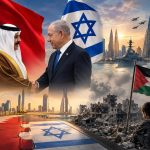
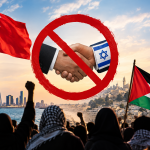
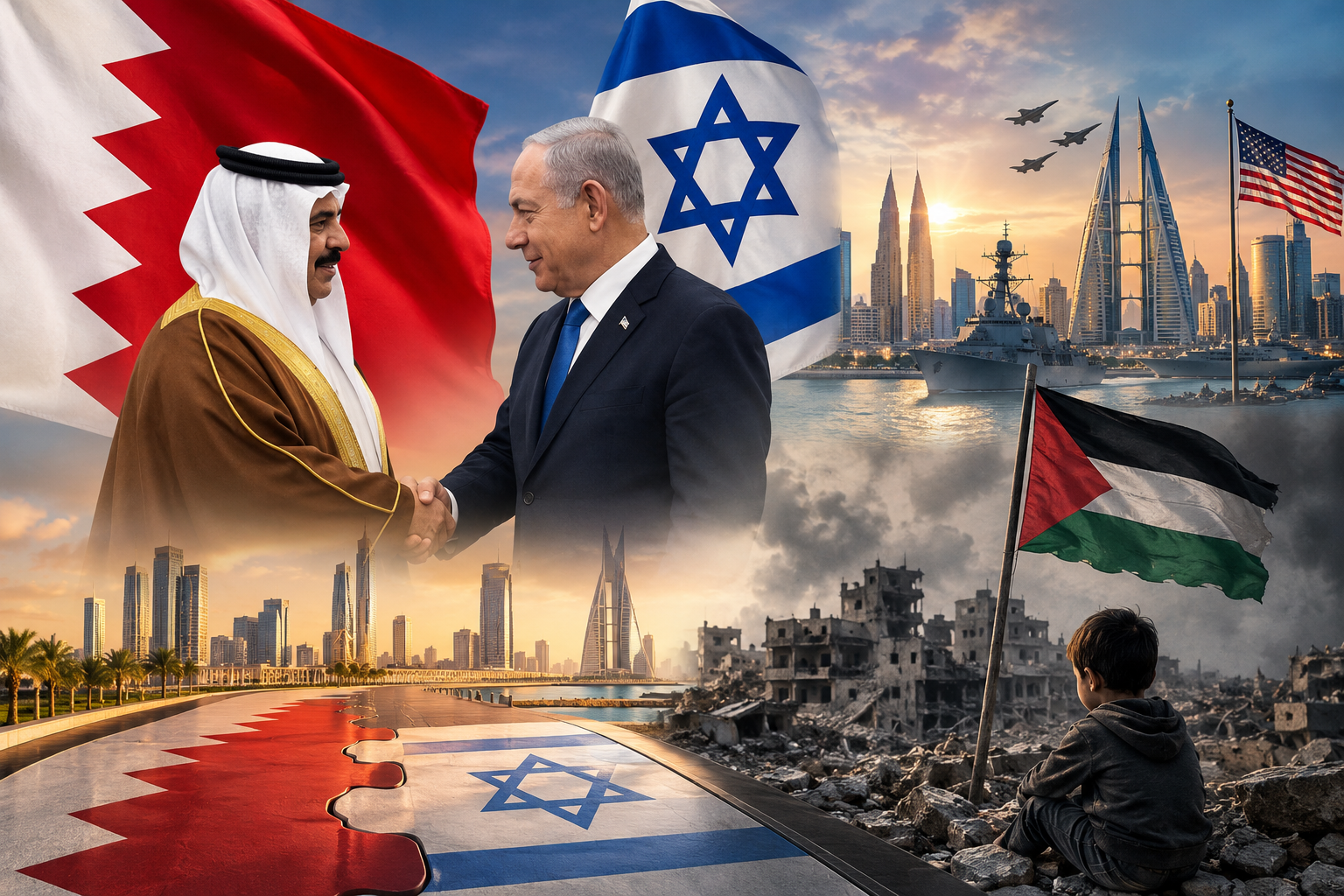
In May 2018, Bahrain’s foreign minister defended “Israel’s right to defend itself.” In June 2019, the Al Khalifa hosted the “Peace to Prosperity” conference, associated with the Deal of the Century. In October 2019, Israeli officials visited Bahrain to participate in security and religious conferences. These developments culminated in September 2020 with the announcement of full diplomatic normalization.
How did relations between the Al Khalifa and the Zionists evolve after the normalization agreement in 2020? How did the genocidal war in Gaza reveal the full convergence between the two sides?
It is important to review the timeline of relations between the Al Khalifa and the Zionists following the announcement of normalization in order to understand what this analysis describes as their dual hostility toward the people of Bahrain and the people of Palestine alike.
In September 2021, the Israeli embassy opened in Manama. In February 2022, Israeli Prime Minister Naftali Bennett and Defense Minister Benny Gantz visited Manama and signed a security and intelligence cooperation agreement—the first of its kind with a Gulf state. In March of the same year, the Bahraini regime participated in the Negev Summit, which preceded the genocidal war on Gaza.
One month before that war, Israeli Foreign Minister Eli Cohen arrived in Manama to inaugurate the permanent premises of the Israeli embassy.
Despite the symbolic and temporary downgrading of relations between the two sides in response to public and international outrage over the crimes committed in Gaza, the Al Khalifa did not conceal their alignment with the Israeli narrative regarding October 7, describing the resistance as “savage.” They also continued, according to this account, to provide assistance to the Israelis against the resistance in Gaza and Lebanon in particular, and received the new Israeli ambassador in August 2025.
In short, the public communication between the ruler and the Israeli president, Isaac Herzog, in July 2026 represents the culmination of the story of convergence between the two entities—specifically, a convergence in the “identity” of occupation, criminality, and the ethnic cleansing of indigenous populations.