Political Analysis (15): The Tyrant Receives a British Military Official on the Eve of “Independence Day” — How Did the Al Khalifa Turn Bahrain into a Colony in Every Sense of the Word?
This year’s “Bahrain Independence Day” came as the Al Khalifa authorities provided further evidence that this country has enjoyed no genuine independence since the Al Khalifa occupation at the end of the eighteenth century, and that its defining characteristic has been the regime’s persistent insistence that foreigners have always been the foundation of its existence and the secret behind its survival to this day.
Before the American war on Iran (February 2026), there may have been some room for superficial debate and back-and-forth discussion, including arguments some might have made regarding the public admission made by “the tyrant Hamad” to the British years ago, when he said that none of his fathers or forefathers had ever asked the British to leave Bahrain, and that they had never, at any point, been a colonial power in the country. But after the war on Iran, there is no longer any doubt or hesitation in placing the Al Khalifa, at the head of the list of agents of colonialism and global arrogance.
Why did the tyrant Hamad choose to receive a British military official in the atmosphere surrounding Independence Day? And is the presence of a model of Khamis Mosque a means of concealing aggression against the people and subservience to the enemies of the nation?
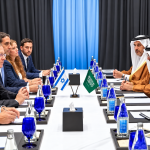
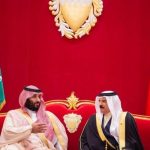
In the atmosphere surrounding Independence Day this year, “the tyrant Hamad” chose to receive Charlie Collins, the British Deputy Chief of the Defence Staff for Strategic and Operational Affairs, in a behavior he has resorted to whenever he finds himself in a new predicament—internally or externally—and knows of no way out of it except by deepening the predicament and sinking further into it.
If we consider the context of the new open-ended war against everything connected to the people, their identity, and their history, we must not underestimate the significance of this military official’s visit to the country, or his meeting with the tyrant and the rest of the Al Khalifa military officials.
In this regard, attention should be drawn to the message conveyed by the “image” that was intended to be circulated during the reception of the British official. A model of Khamis Mosque (the Two-Minaret Mosque) was placed in front of Hamad, with the Holy Qur’an behind it.
This is an exposed ploy intended to cloak the tyrant and his illegitimate regime in a religious appearance, in the hope of repairing his image, whose darkness has become evident through his open hostility toward the beliefs and religious practices of citizens on the one hand, and his absolute subservience to the enemies of the nation—the Americans and the Zionists—on the other.
What happened between 2023 and 2026 regarding violations of sovereignty and national independence in Bahrain? And how did the war of annihilation in Gaza and the aggression against Iran constitute a complete test of the Al Khalifa’s subordination to the forces of aggression?
The Al Khalifa have placed Bahrain, during the years 2023–2026, in the worst political and sovereign situation the country has experienced in many decades. From Operation Al-Aqsa Flood and the war of annihilation in Gaza through to the war of aggression against Iran, the tyrant Hamad has violated every boundary of Bahrain’s sovereignty, national independence, and statehood, to a degree surpassing everything the country suffered before independence and everything that occurred afterward.
Prior to that, Bahrain had faced numerous challenges arising from the absence of a social contract and the lack of popular and constitutional legitimacy of the Al Khalifa, alongside the implementation of two interconnected strategies targeting the very existence of the indigenous population.
The first was a strategy of violating the dignity and self-respect of citizens through various processes of impoverishment and corruption; the second was a strategy of destroying the identity and history of citizens through an interconnected series of persecution and the erasure of historical memory.
While ties to foreign powers and the erosion of sovereignty had long been central issues in political debate, this matter underwent its ultimate test following the war of annihilation in Gaza and the aggression against Iran. The final piece of covering fell away, revealing the highest degree of absolute subordination binding the Al Khalifa to foreign forces of aggression.
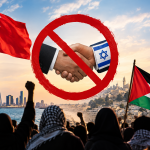
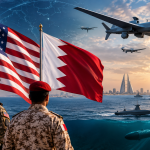
This has been manifested through American military bases, normalization, and Zionist surveillance platforms established in the country, as well as through integration into alliances hostile to the values of the region and its peoples.
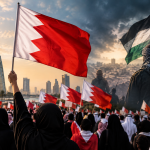
Why has Bahrain’s Independence Day now become burdened with factors that diminish the people’s ability to celebrate it?
In previous years, Independence Day represented an occasion to remember the national struggle and honor the prominent figures of whom the people of Bahrain are proud for the sacrifices they made in the struggle to expel the British colonizer from the country.
Today, however, this occasion has become burdened with factors that cloud the Bahraini people’s ability to celebrate it—an occasion that has, in the first place, been excluded from the Al Khalifa’s official calendar.
The country that, after the year 2000, had caused citizens to lament that it had become exposed to foreigners and mercenaries has now confirmed that it has become completely stripped of its will and sovereignty, as a result of its absolute alignment with the most egregious forces of aggression and global arrogance in history, in order to manage their crimes in the region and the world.
Did Bahrain actually gain independence after 1971? Why did the British return militarily? And how has the country today become a colony in every sense of the word?
An analysis of the facts and historical milestones brings us face-to-face with realities that may be deeply unsettling to many. The first of these realities is that Bahrain did not, in fact, gain independence after the British withdrawal, because it remained under Al Khalifa occupation.
The Al Khalifa occupiers succeeded repeatedly in thwarting the people’s struggle to establish a constitutional state that was independent in both its internal and external decision-making.
This reality produced a further consequence: the Al Khalifa occupation attracted various forms of occupation, both large and small, including their occupation of the history and identity of the Baharna people, and their occupation of their culture, rituals, and religious practices, eventually extending to the attraction of direct military occupations, including the return of the British to the country once again through military bases.
British and American military commanders have assumed responsibility for all security and military affairs in the country, determining Bahrain’s strategic and military affairs, including identifying its “enemies” and formulating policies of war and hostility toward neighboring countries.
It is therefore evident that Bahrain has, in practice, become a colony in every sense of the word—openly and in broad daylight.