Political Analysis (12): The Hell of American Bases in Bahrain… Al Khalifa’s Pursuit of Foreign Protection: From Military Bases to ISIS
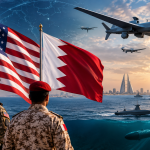
The American military bases in Bahrain cannot be regarded as merely a logistical detail. The selection of Manama as the headquarters of the U.S. Fifth Fleet signifies that the United States has made the country a central hub for directing its military operations throughout West Asia. This is evidenced by numerous facts and developments, including the presence of the United States Central Command (CENTCOM) in Bahrain and the repeated visits of its commander, Brad Cooper, who has met with Bahrain’s ruler, Hamad Al Khalifa, and other members of the ruling family who oversee the country’s security apparatus.
To what extent do the American military bases in Bahrain undermine the country’s sovereignty? What are the principal bases whose roles became evident during the aggression against the Islamic Republic?
According to the article, the Al Khalifa family views the foreign military presence as a privilege that provides sufficient guarantees for preserving its rule. Consequently, the American bases effectively shape the system of governance in Bahrain and exert a direct influence over the country’s internal dynamics and the regime’s external relations. As a result, the bases are portrayed as a clear manifestation of the violation of Bahrain’s sovereignty on the one hand, and of the Al Khalifa family’s dependence on the United States on the other.
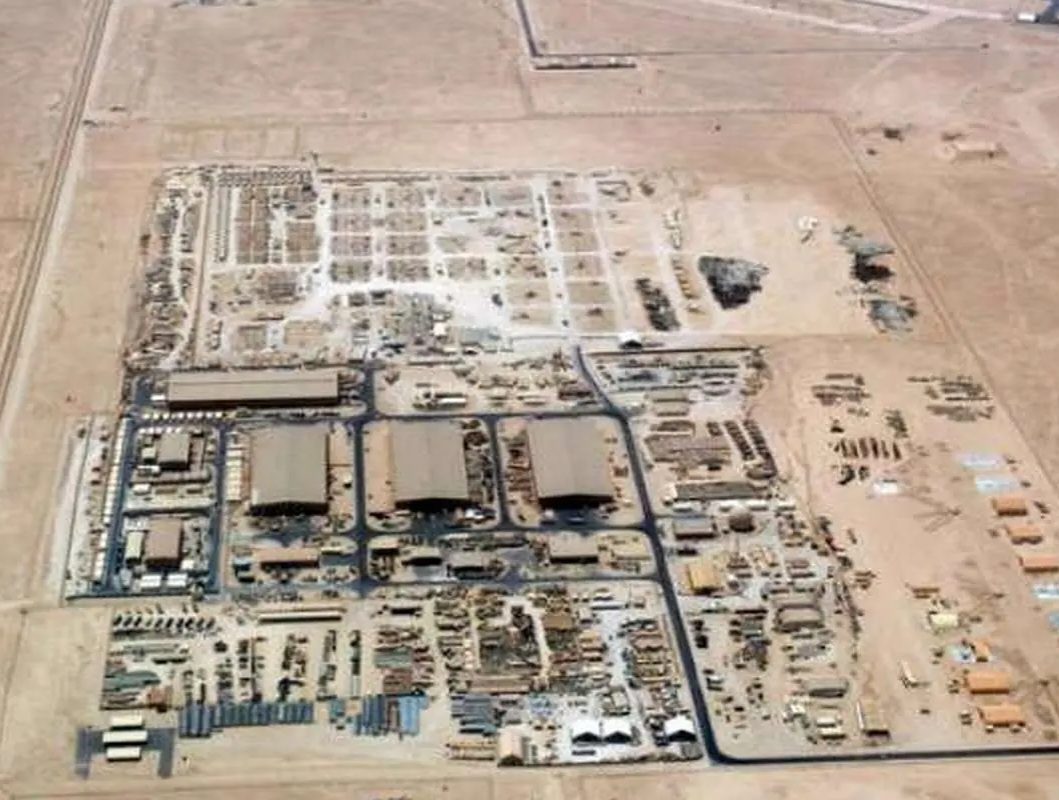
Since the beginning of the U.S.-Israeli military campaign against Iran, the issue of American military bases in Bahrain has come to the forefront. The U.S. command headquartered in Bahrain emerged as the central authority directing military operations against Iran. This became evident through the Iranian strikes targeting these facilities, particularly Naval Support Activity Bahrain (Juffair Naval Base), which serves as the headquarters of the U.S. Fifth Fleet and U.S. Naval Forces Central Command. The military campaign also revealed another vital installation, Isa Air Base in Sakhir, which was likewise targeted by Iranian attacks.
What are the primary objectives of the American military bases in Bahrain? Did they achieve their intended goals during the military campaign against Iran?
In light of the ongoing U.S. campaign against Iran, several objectives underlying the American military presence in Bahrain can be identified. Operationally, these bases have assumed key roles in directing U.S. regional operations, including both military and intelligence activities. Iran has asserted that a number of the attacks carried out against it during the war were launched from these bases, including the strike that allegedly resulted in the massacre at the girls’ school in Minab. Moreover, the presence of CENTCOM in Bahrain makes it inherently involved in all U.S. military operations throughout West Asia. Given their operational responsibilities, the American bases have also served as command centers for controlling maritime routes in the Gulf and enforcing the blockade of Iranian ports, including the Arabian Sea and the Strait of Hormuz. Ultimately, the U.S. military installations in Bahrain constitute an advanced forward operating platform for conducting hostile operations against Iran, particularly naval and aerial attacks.
Following the Islamic Republic’s exercise of what it describes as its legitimate right of self-defense in response to the aggression, what damage and serious consequences have the American bases inflicted upon Bahrain?
In practical terms, the American military bases in Bahrain have exposed the country to its most serious security threat in decades. As Iran was compelled to wage an unconventional conflict—whether by threatening the closure of the Strait of Hormuz or by expanding strikes against strategic infrastructure supporting hostile military activities—Bahrain remained at the top of what the article describes as Iran’s “target bank” throughout every round of confrontation between Iran and the United States. The American bases, military facilities, and supply depots spread across the country became the primary targets of Iranian ballistic missiles and unmanned aerial vehicles, with approximately 200 ballistic missiles and more than 468 drones reportedly directed at them.
The article further argues that, over the past two decades, the Al Khalifa regime has effectively placed Bahrain’s territory and airspace at the disposal of regional and international foreign powers in exchange for financial support and political protection. This, it contends, has included granting extensive access to American, British, Israeli, and other intelligence agencies, transforming Bahrain into one of the Gulf’s largest hubs for espionage and covert security operations. According to the article, cyber warfare, electronic surveillance, and clandestine operations are coordinated from the country under the cover of Amazon and other commercial entities, with neighboring states and resistance movements being the principal targets. Within this context, the article argues that the widespread Iranian cyberattacks against Bahrain’s digital infrastructure, cloud servers, radar installations, and telecommunications towers—deployed across the country under the guise of local companies and institutions—were directed at facilities that allegedly provide critical operational data for U.S. military operations and intelligence, surveillance, and reconnaissance missions.
Following the failure of the American bases to achieve the objectives of what the article describes as a campaign of sectarian cleansing against Bahrain’s Shiite population, is the Al Khalifa regime now seeking to recruit extremist elements from Syria?
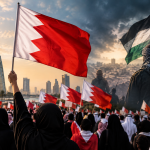
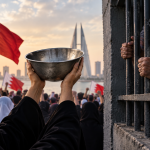
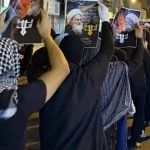
The article contends that the campaign against Bahrain’s Shiite community, led by King Hamad under the cover of the U.S. campaign against Iran, represents a clear manifestation of one of the principal functions of the American military presence in the country, namely providing political cover for actions and violations committed against citizens and opposition groups. According to the article, these policies will only deepen divisions within Bahraini society and reinforce the population’s estrangement from the Al Khalifa regime, particularly in light of what it describes as Iran’s liberation-oriented approach, its support for the oppressed, and its longstanding strategy of strengthening the Axis of Resistance and its constituent peoples, including the people of Bahrain.
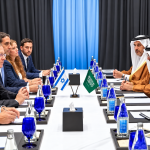
The article concludes that the Al Khalifa family will ultimately recognize the limitations of relying on American military bases for its security, arguing that states facing profound crises cannot secure lasting stability through imported protection—whether from the United States, foreign mercenaries, or what the article describes as ISIS terrorists whom, according to some observers, the Bahraini authorities are seeking to recruit from Syria. This interpretation is linked to the Bahraini Interior Minister’s visit to Damascus on 21 July, which some commentators view as reflecting the ideological affinity they claim exists between the Al Khalifa family and the armed groups currently controlling Syria, asserting that both ultimately operate under American patronage. The article concludes by predicting that the Al Khalifa leadership will ultimately descend to “a new low in the pit they have dug for themselves.”