
Political Analysis (21): Why Do the Al Saud Not Abandon Takfir and the Incitement of Electronic Armies?
The Lie About the Attack on Mecca: A Perpetual Doctrine of Stirring Up Discord
Many analysts paused to examine the latest disinformation campaign launched by the Al Saud—and joined by large numbers and groups from within Saudi Arabia and abroad—against the Ansar Allah movement in Yemen, through fabricating the accusation that it had attacked Mecca.
Although the Saudi regime has a history of repeated disinformation campaigns and of creating electronic armies, some were surprised by their persistence in pursuing the same misleading campaigns, which had previously failed to achieve their intended political objectives. Yet the issue that requires attention here is that the Al Saud are not primarily concerned with achieving political objectives. In reality, they are far removed from formulating strategic policies related to projects that serve the general interest.
The Al Saud have never moved beyond the sphere in which they are most adept: sectarian incitement, tearing the nation apart, and inventing sectarian propaganda and rhetoric that distract the nation from its real enemies and from confronting the genuine challenges it faces, while instead preoccupying it with disputes dating back to the earliest centuries of Islam.
Did Mohammed bin Salman’s Break with “Wahhabism” Affect the Identity of the Saudi Entity? Was It a Means of Facilitating Authoritarianism and Satisfying the Outside World, or a Step Toward State-Building?
Some may believe that the Al Saud have brought about a change in their established identity, which has been based on sowing discord, creating division, and inflaming sectarian disputes. They point to Mohammed bin Salman’s sweeping “break” with the identity of the Saudi entity, particularly in terms of restricting the Wahhabi identity, curbing religious extremism, and closing the domestic public sphere to traditional clerics.
However, what Mohammed bin Salman did was connected to a project of seizing power and achieving complete influence over the affairs of the Saudi entity, in a manner that strengthens his ability—and that of his team—to facilitate the entity’s involvement in the projects and agendas of external powers.
Accordingly, the removal of “Wahhabism” was nothing more than an attempt, on the one hand, to improve the Al Saud’s image abroad and, on the other, to create a new reality in Saudi Arabia that would contribute to deepening direct and indirect, security and cultural, control over citizens’ public lives, as well as over young people and society’s various actors and forces.
In other words, the “new Saudi Arabia” introduced by bin Salman was intended to diversify forms of authoritarianism, transform institutions and programs of corruption into tools serving authoritarianism and control over society and the system, and strip it of any sources of opposition or competing power.
What Is the Connection Between the Al Saud’s Dark History of Sectarian Incitement in Bahrain and Syria in 2011 and the Lie About the Attack on Mecca?
The year 2011 marked the peak of the sectarian propaganda and incitement exploited by the Al Saud to advance their domestic and foreign policies. Bahrain was then a testing ground for this obsession with stirring sectarian divisions and employing them to suppress protest movements and distort their national backgrounds.
The same pattern was repeated in the Syrian conflict, as the Al Saud and the Gulf regimes participated in inflaming sectarian conflict within Syrian society on an unprecedented scale, after linking this incitement to armed groups.
At that time, sectarian incitement was not limited to sectarian rhetoric and takfirist religious edicts. All of this was put into practice on the ground through takfirist militants, the intensification and explosion of sectarian tensions through “massacres,” and fighting along sectarian lines and under slogans invoking the wars between sects of earlier eras.
If we recall the masses who joined the Al Saud and the Gulf regimes, as well as the participation of “religious figures,” religious institutions, and others in this bloody sectarian madness, it is not difficult to understand the return of these same groups with the lie about the attack on Mecca and the sectarian misinformation that accompanied it.
Why Have the Al Saud Not Abandoned Takfirist Religious Edicts After the Fall of the Assad Regime? And Why Is bin Salman Unable to Move His “New Saudi Arabia” Beyond the “Takfirist Armies”?
After the fall of the Assad regime and the beginning of the task of reshaping and rehabilitating the takfirist armed groups—at least in appearance—to make them suitable for governing the new state in Syria, the Al Saud—as well as the Gulf regimes that financed sectarian killings and armed sectarian groups in Syria—resorted to inventing new forms of rhetoric and introducing them into the Syrian scene.
These included themes such as political pragmatism, state-building, pluralism, as well as peace with the Zionist entity and moving toward, to the point of convergence with, the American agenda.
In light of this, some believed that the Al Saud would go further in building the “new Saudi Arabia,” including eradicating all sectarian tendencies and refraining from once again resorting to tools of sectarian conflict, including suspending takfirist religious edicts, restraining the electronic armies specialized in exploiting creeds and sects to ignite divisions and distract people, and serving political agendas.
But this assumption was not correct at all.
Is the Moral Disintegration and the Culture of Parties in Saudi Arabia the Other Face of Using Religion for Political Purposes?
The nature of the Saudi entity is based on a sectarian obsession, and no matter how much bin Salman or anyone else changes the entity’s external appearance, its essence remains embedded in an identity extending back to the fateful founding of the Arabian Peninsula.
Therefore, the return of sectarian-based misinformation, in the context of the escalation between the Al Saud and Yemen, was not surprising at all. Nor is it inconsistent with the Al Saud’s new “corruptive” guise.
It can be said that the use of sectarianism and religion for the purposes of political conflict and settling scores between opposing blocs is the other face of the Al Saud’s persistence in spreading moral disintegration and parties that are incompatible with general religious and social norms.
In both cases, the Saudi entity plays its role in fragmentation, division, and putting people into a state of political and social stupor. It thereby turns societies into an open space without restraints, lacking a coherent identity connected to the broader framework of the nation, and instead filled with gaps, divisions, and sectarian resentments.
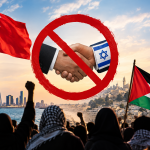
It becomes completely dependent on hegemonic powers and on centers that produce entertainment and consumer culture. The rulers, consequently, find themselves with no red lines restricting them from doing whatever they wish or issuing whatever decisions they want, even when those decisions conflict with religious values, sacred principles, and social customs—even when their outcome is the clasping of hands and the exchange of kisses with American and Zionist criminals and corrupt figures.