Political Analysis (20): Toward a Common Project to Confront the Gulf Regimes — The Escalation of Repression and Persecution and the Path to Normalization
The signing by the Al Khalifa of normalization agreements with the Zionist entity was not merely a matter of following and replicating the Emirati position. Rather, it can be argued that the Al Khalifa were among the first to establish relations with the occupying entity and to regard an alliance with this enemy as a strategic option that was indispensable to completing the security-and-protection framework.
Although some analysts believe that the Al Saud gave the Al Khalifa the green light in September 2020 to sign normalization agreements alongside the Emirati regime, this does not mean that the Saudis share the same reasons as the Al Khalifa for pursuing normalization in the near or medium term. Saudi Arabia ultimately represents a geopolitical space with its own interests, conflicts, and challenges, distinct from those of the other Gulf regimes. Moreover, its traditional self-presentation as the “Land of the Two Holy Mosques” imposes its own considerations upon it. Therefore, it is unlikely that the Al Saud would rush toward direct normalization, particularly with the genocidal character of the Zionist entity’s actions having become increasingly evident since October 7. Instead, they have intensified their excesses in domestic repression and corruption and gone further in their reckless and ill-considered adventure in the war against Yemen.
Why are the Al Khalifa unable to coexist with the indigenous citizens? And what is the relationship between normalization with the enemy entity and this Al Khalifa legacy?
The Al Khalifa understand that they are not prepared to coexist with Bahrain’s indigenous citizens, not only because they are unable to rid themselves of the legacy of an invasion that has lasted for more than 250 years, which renders them unqualified to build a genuine state, but also because Bahrain’s citizens themselves possess a historical and cultural continuity—a deeply rooted collective identity—for which there is no equivalent on the other side, nor anything that intersects or reconciles with it.
In other words, the absence of the foundations for encounter, communication, trust, and joint nation-building between the Al Khalifa and the people of Bahrain places the two sides in separate spheres that grow wider with each passing day, eliminating any possible space for convergence and mutual acceptance.
This fundamental distinction, rooted in the conflicting identities of the two sides, is manifested in practice in the answers to the following questions: What kind of state is appropriate for Bahrain? Which political system is best suited to achieving its objectives and is actually viable? Who is the enemy and who is the friend, particularly with regard to external alliances?
Why does repression and persecution increase as the Al Khalifa deepen their normalization? And does opposition to normalization entail rejecting the Al Khalifa regime?
Since their occupation of Bahrain and to this day, the Al Khalifa have imposed a structure resembling a tribal state, from which emerged a political system based on discrimination and privileges for the ruling family and its followers, while antagonizing the population at large.
At the external level, this was accompanied by the establishment of relations and alliances that correspond to the tribal mentality and its characteristics, serving policies of monopolizing power and spoils, as well as institutionalized corruption through discrimination and privileges.
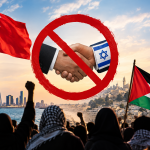
This entire reality constituted the groundwork upon which the protests and uprisings witnessed by Bahrain over the course of decades were founded, including popular protests specifically opposing the normalization agreements and the opening of the entity’s embassy in Manama.
At their core, these protests were not limited to opposing normalization—as one form of the regime’s foreign relations—but also touched upon deeper roots connected to the three questions mentioned above, the coercive answers imposed by the Al Khalifa to those questions, and the crises and confrontations that resulted from them, placing heavy burdens upon the people and the country and creating thick barriers and sharp divisions between the Al Khalifa and the people of Bahrain.
As a result, opposition to normalization became opposition to the regime and its abnormal nature. Likewise, declaring opposition to the normalization agreements became another expression of opposition to the identity of a regime that is incompatible with the identity of its citizens, their choices, and their answers to the questions of the state, the political system, and external alliances.
What is the situation in Bahrain six years after the anniversary of the ill-fated normalization agreements?
With the arrival of the sixth anniversary of the ill-fated “Abraham Accords,” it can be observed that the Al Khalifa have become more aggressive toward the people and more ruthless in confronting their identity, religious practices, and historical roots.
This may appear “logical” if we examine normalization from the perspective outlined above. The more the Al Khalifa deepen their alignment and integration with the Zionists, the more they expand the scope of authoritarianism and intensify repression and persecution, while extending their alliance with external forces of hegemony and, at the same time, turning the country into open platforms for foreign projects involving aggression, the fomenting of wars, and the incitement of discord.
Therefore, as a consequence, political struggle in Bahrain and adherence to political demands—foremost among them the establishment of a political system based on the will of the people—constitute the other side of confronting normalization and rejecting alliances with forces of aggression, and vice versa.
Do normalization agreements extend to the rest of the Gulf regimes? And why is Kuwait in the danger zone?
This issue can also be applied to the other Gulf states, particularly those reportedly being considered for involvement in the disgrace of normalization, as has recently been reported with regard to Kuwait.
Over the past few years, the Kuwaiti regime has accelerated its policies aimed at undermining public freedoms and has evolved into a repressive and corrupt regime that has been the subject of strongly negative assessments in reports by human rights organizations.
This became the basis for launching campaigns of a sectarian nature against Kuwaiti citizens, criminalizing Shiite religious practices, and subsequently becoming openly involved in hostility toward the resistance front, criminalizing any support for or endorsement of it, imposing unjust trials, and revoking the citizenship of those accused of such activities.
The separation of Kuwait’s rulers from the remaining features of a democratic state, together with the declaration of a war on identity and religious persecution against citizens, constituted the logical prerequisites for their move toward alignment with forces of aggression, as demonstrated by their complicity in the war imposed on the Islamic Republic.
According to this analysis, this trajectory would naturally culminate—sooner or later—in normalization with the Zionist occupying entity.