Political Council of the 14 February Youth Coalition: The Options of the Al Khalifa: The Announcement of the “Emirati–Israeli Alliance”.. and the Erosion of U.S. Hegemonic Policies
The Political Council of the 14 February Youth Revolution Coalition launched a political analysis series, in which it addresses the situation of the region and Bahrain amid the unfolding events.
The first episode of this series was titled: The Options of the Al Khalifa: The Announcement of the “Emirati–Israeli Alliance”.. and the Erosion of U.S. Hegemonic Policies, and it stated:
In the late 1960s, the Gulf region witnessed the withdrawal of British colonialism due to complex factors, after which the United States began inheriting the colonial legacy through its successive dominance and control over the peoples and resources of the region. Following the pattern of the old colonial model, the Americans assumed the protection of illegitimate tribal regimes, and a U.S.–British understanding was reached to design a geopolitical framework to secure their interests in the region. At that time, this was based on a policy of merging nine rival tribes into what was then called the “Nine Emirates Union,” which includes what is now known as the United Arab Emirates, in addition to Bahrain and Qatar. The belief was that this merger policy would provide the new American colonial power with greater flexibility in protecting the small sheikhdoms in Doha and Manama against Saudi Wahhabi expansion on one hand, and the growing expansion of the Shah’s government in Iran on the other.
At that time, tribal conflict in the Gulf continued, and with it the concerns of Al Khalifa and Al Thani increased regarding gradual absorption under Abu Dhabi’s dominance. In light of this, the merger project planned by the Americans and the British collapsed, and matters calmed only superficially under the umbrella of the Gulf Cooperation Council, which gave the tribes the impression that it would provide security against the Islamic Revolution.
However, over decades, the new system was shaken, and this formula failed to limit the recurrence of conflict among the Gulf sheikhs, in parallel with the failure of the Americans in their strategies to maintain the stability of a Gulf model under absolute hegemony.
In this context, Al Khalifa emerged as the weakest link in the equation of conflict and domination in the Gulf. The shock of the 14 February 2011 revolution revealed that the Khalifis were on the verge of a catastrophic collapse, had it not been for the requirements of Gulf regimes’ interests, which found themselves facing the test of American maneuvering with the revolutions that the region witnessed at that time. With the shaking of the thrones of the sheikhdoms, Gulf tribes rushed to protect Al Khalifa, and sent armies to suppress the revolution and extinguish its fire in their countries.
During the first years of the revolution, the Khalifis insisted on establishing a Gulf union that would restore a sense of security for the crumbling regime. However, the divergence of Gulf rulers, the contradiction of their interests, and their failure to overcome old tribal rivalries led to the collapse of the dream of Gulf union. It then burned out amid successive Gulf disputes, especially after the aggression on Yemen, followed by the blockade of Qatar, and the expansion of Saudi–Emirati rivalry over spheres of influence in Bahrain, southern Yemen, Sudan, and others.
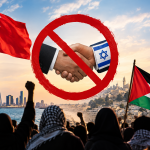
With the lack of hope for the Al Khalifa in a stable Gulf umbrella that ensures their political and economic stability, they chose the most confrontational direction: moving toward normalization with the enemy, through the Emiratis, whose influence has extended into all Al Khalifa affairs. This deepened the duality of the Khalifis’ orientation, and later exploded following the American–Zionist aggression on the Islamic Republic.
The confrontation strategy adopted by the Republic in response to the aggression will have major repercussions in redrawing the region and the colonial maps that have prevailed for decades. Alongside the escalating conflict among Gulf tribes and the continuous erosion of external protection systems, the options available to these tribes will not be many: either they respond to popular will and sever their foreign relations, or they enter new rounds of confrontation and the rebuilding of alliances.
For the Al Khalifa, their reckless alignment with the Emirati regime will push them toward the old formula, namely under the umbrella of the United Arab Emirates, as a prelude to dissolving the Gulf Cooperation Council, and then announcing an alliance managed by “Israel” and blessed by the Americans. It is certain that this will mean that the Al Khalifa will be the first victims of the coming confrontation with Saudi Arabia and its new alliance that is expected to be formed with Ankara, Islamabad, and other regional states. However, this will only be the visible change on the surface; what comes after the aggression on Iran will not be like what came before it.